
The FEAPs Progression Plan: What It Means for Florida Educators | Uncomplicate Ed
Here’s the Gist
Florida's FEAPs (Florida Educator Accomplished Practices) have changed (effective 8/25/26), and a new tool has been created to help educators meet the expectations: the FEAPS Progression Plan.
The Progression Plan is organized around three parts:
Know that...
Learn how to...
FEAP
Statements beginning with “Know that...” focus on what educators need to understand, while those beginning with “Learn how to...” focus on the skills they need to acquire. The FEAP then describes the practice expected of them.
It allows us to think about professional growth in a slightly different way.
An educator might understand an idea yet still require assistance in using it properly. On the other hand, another educator might be able to use a strategy but not fully understand when or why to use it.
The Progression Plan provides schools and districts with a better way to discuss this issue.
Ongoing, job-embedded professional learning remains the most effective way to support educators in improvement (and at Uncomplicate Ed, this is our favorite way to serve). You don't need carved-out, full "PD Days" to have effective PD. uncomplicateed.com/training
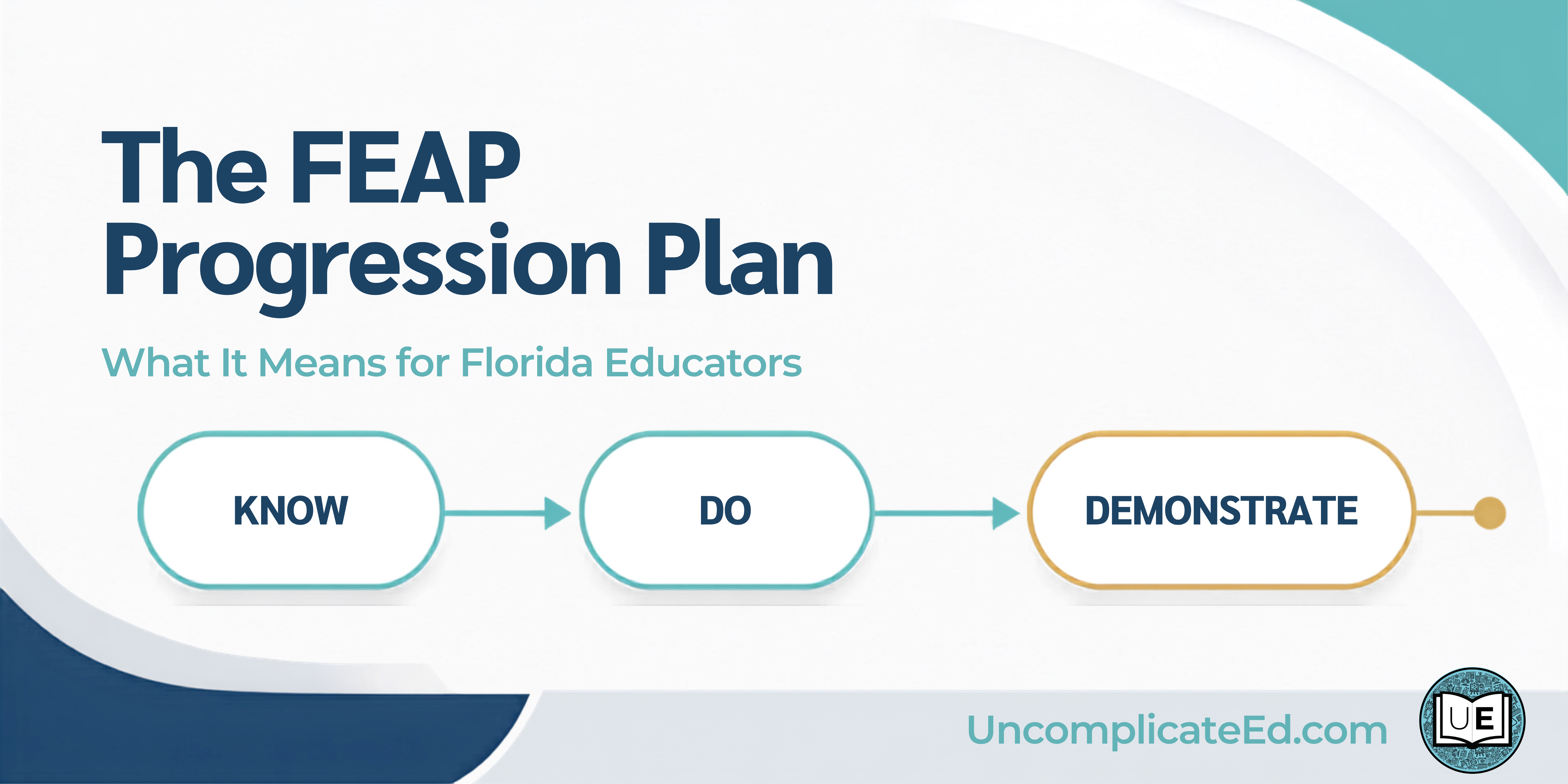
Know → Do → Demonstrate
If you read our first post about the revised FEAPs, you may remember that we used a simple way to think about the Progression Plan:
KNOW → DO → DEMONSTRATE
That remains the simplest way of explaining it.
The FEAPs show us the direction educators are moving in, but the Progression Plan enables us to see more clearly what they might need to learn at various stages.
How Does This Appear in Actual Situations?
Take checking for understanding.
Most educators realize they need to check for understanding, but that doesn't mean all teachers do it the same way (or with the same impact).
One teacher might need more strategies, while another might already know many strategies but still have difficulty using them during teaching. A third might check frequently but not make much use of the information students provide.
The teachers won't require the same level of support.
The Progression Plan is useful here because it lets us take it slow and decide whether what is needed is more knowledge, more practice, better feedback, or a mix of all three.
What This Could Mean for Professional Learning
This might be where I see the greatest opportunity.
We have all taken part in professional development where a subject is taught, people receive a handout or a slide deck, and then we hope it ends up in the classrooms.
Sometimes that works, and sometimes people end up knowing more, yet still need help turning that knowledge into practice.
The Progression Plan helps us be more intentional. If educators are to make good use of that idea, they will probably need to have it demonstrated, practice it, get feedback, and then return to it once more.
It's easy to skip the middle part.
What Ongoing Professional Learning Can Look Like
Ongoing, job-embedded professional learning does not require a full PD day.
Some of the most useful learning can happen in much smaller, more focused bursts, especially when it is tied to the work educators are already doing.
That might look like bringing in subs so that a grade-level team can co-plan or get differentiated learning. It might be 30 to 45 minutes during collaborative planning or a PLC to look at student work, talk through current data, co-plan an upcoming lesson, or solve a problem that is showing up right now.
Sometimes the best next step is modeling a lesson and debriefing it together. Sometimes it is coaching a teacher through a specific instructional move. Sometimes it is helping a coach think through how to support someone else.
Did you know we offer this service? At Uncomplicate Ed, this is one of our favorite ways to serve because the learning stays connected to real classrooms, real students, and real decisions.
You do not need a carved-out “PD Day” to make professional learning useful.
You need time, focus, and a clear problem of practice.
And when that support happens over time, educators get the chance to learn something, try it, come back with questions, look at what happened, and keep improving.
Want to learn more about our PL? Check out our PL page HERE or reach out to me directly at [email protected]
Different Roles Will Use It Differently
A superintendent could review the Progression Plan and consider whether the district's priorities, professional learning, and evaluation processes are all heading in the same direction.
A professional learning leader can use it to consider which topics educators should learn first and which will require more time and practice.
A principal can use it to make feedback more specific.
A coach can use it to work out what sort of support a person needs.
A mentor teacher can use it to help a less experienced teacher understand the reasoning behind ordinary instructional decisions.
A teacher can use it to think about her current situation and about what she would like to work on next.
Same plan; different responsibilities.
One Thing We Hope Does Not Happen
We mentioned this in the first FEAP post, but it's worth repeating.
Please don't turn the Progression Plan into a checklist.
I know, it would be very easy to do. After all, it gives careful attention to detail, is well-organized, and uses clear language. It would be easy to turn it into a walkthrough form with boxes to check for compliance. A better approach is to encourage more substantial discussion of learning and growth.
What does this educator know?
What do they still have to learn to do?
What could help them to make progress?
Such questions are far more useful than merely asking if something was seen.
So, What Happens Next?
The Progression Plan offers Florida's schools and districts a fresh approach to supporting educators' growth.
What happens next will depend on how people use it.
It could help make professional development more focused. It could make coaching more useful. It could help principals to give clearer feedback. It could help teachers see a more manageable next step rather than feeling as though they have to improve everything at once.
We will continue our examination of the revised FEAPs, the Progression Plan, cognitive science, and the implications of all this for educators and leaders all over Florida.
For now, the Progression Plan gives us one more tool for answering a pretty important question:
What does a teacher need to keep improving?
In Case You Skimmed: TL;DR
Florida's revised FEAPs now comprise the Florida Educator Accomplished Practices Progression Plan.
It is structured around Know that..., Learn how to..., and FEAP.
We have adopted KNOW → DO → DEMONSTRATE as a simple way of thinking about it.
The greatest opportunity lies in its ability to help schools and districts become more specific regarding what educators will need next, such as additional knowledge, more practice, feedback, coaching, or support.
The plan is only one element of the entire task; how we use it is what will count.
Uncomplicate Ed offers PL and resources on B.E.S.T. Reading and Math built on cognitive science principles and developed by real Florida educators.


