
Learning Styles Are Back From the Dead. Again.
Students learn best when instruction is matched to their individual learning style: visual, auditory, or kinesthetic. True or false?
TL;DR: What Teachers Need to Know About Learning Styles
One of education's most familiar ideas isn't supported by the evidence.
Having a learning preference isn't the same as learning better that way.
Learning-style labels might be limiting the very students we're trying to support.
The best instructional approach depends on what's being taught, not who's supposedly learning it.
Letting go of learning styles might actually make teaching easier.
FREE DOWNLOAD -- Stop planning for labels Start planning for learning.
A couple of years ago, Richard Culatta wrote an ASCD article called Attack of the Zombie Learning Theories! about ideas that have been thoroughly debunked by research but somehow keep wandering through schools anyway.
I love the metaphor.
Especially because some of these zombies are very much still alive.
Recently, I was working with a large group of secondary math teachers and opened our session with a few true-or-false questions. Everyone responded at the same time, so I could quickly see what the room was thinking.
One of the statements was:
Students learn best when instruction is matched to their individual learning style: visual, auditory, or kinesthetic. True or false?
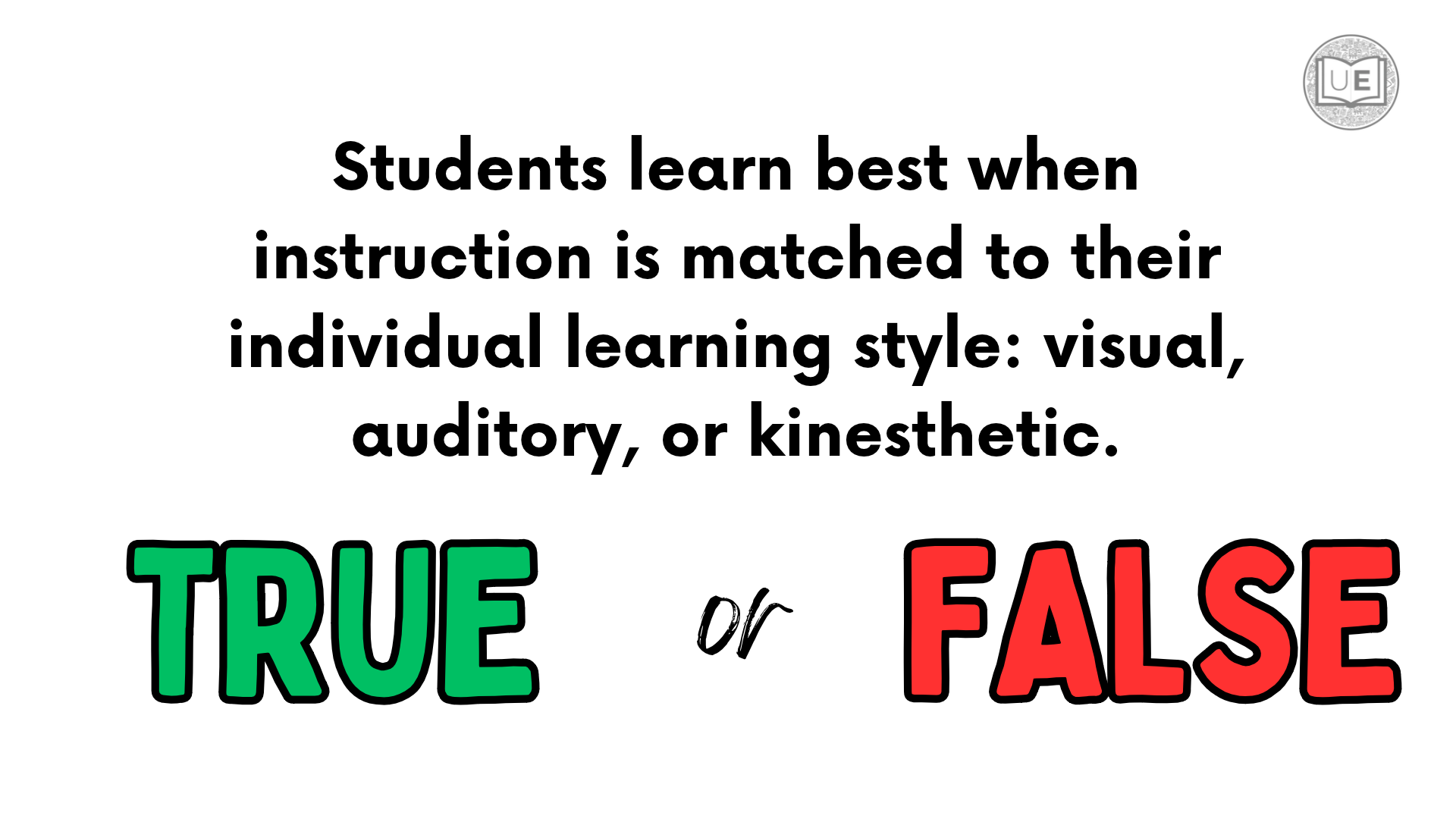
This one seemed almost too easy. There was very little hesitation. Nearly everyone answered true.
Then I told them the answer was false.
The room changed immediately.
They weren’t defensive. They were genuinely surprised. A few people wanted to see the research, which I loved. We need more educators asking, What’s the evidence for that? Especially when something challenges an idea we’ve heard for years.
That’s the thing about learning styles. A lot of us weren’t taught them as a theory that might or might not hold up. We were taught them as simply how people learn.
Learning styles seemed like the perfect place to start.
The Zombie
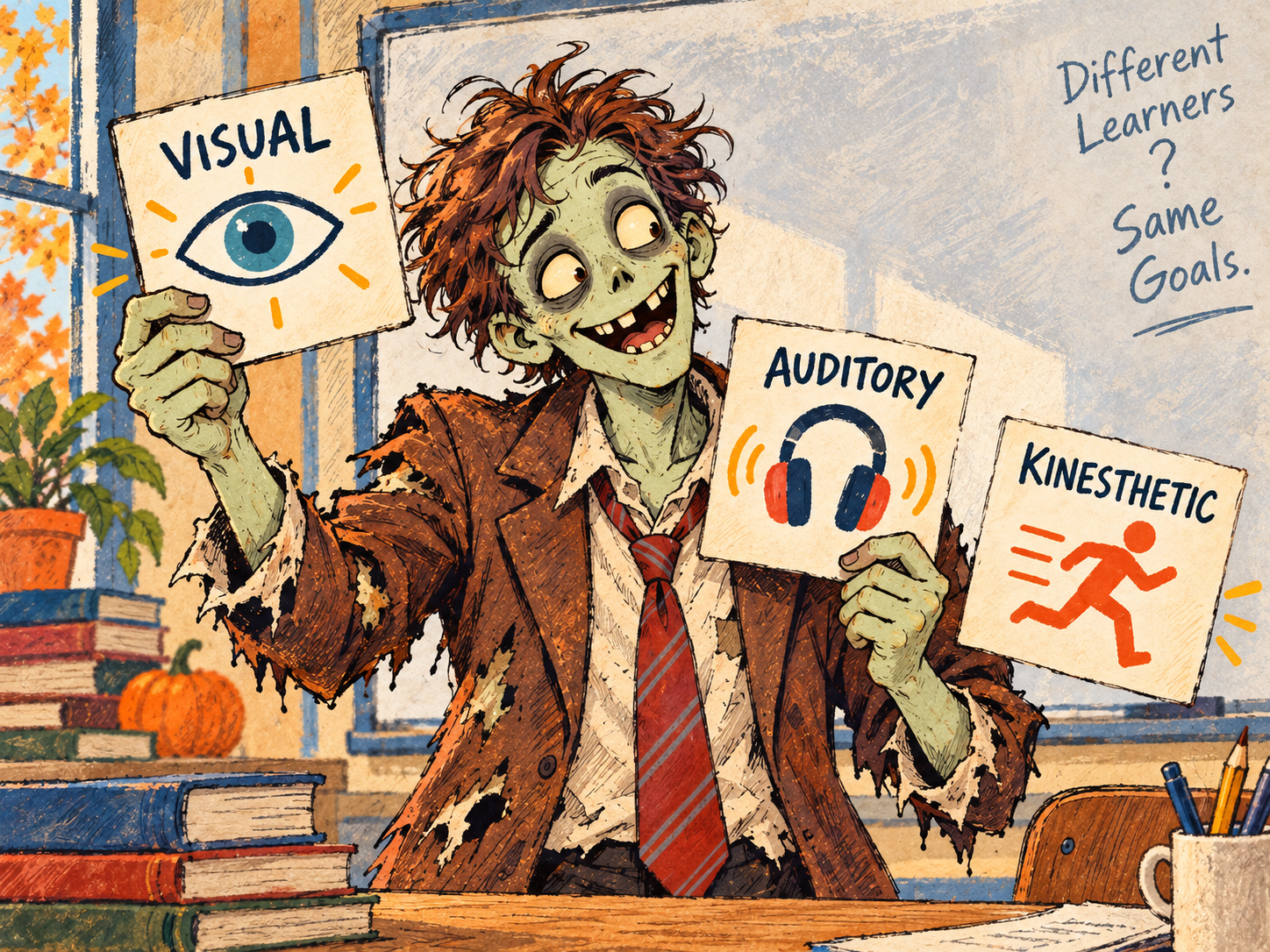
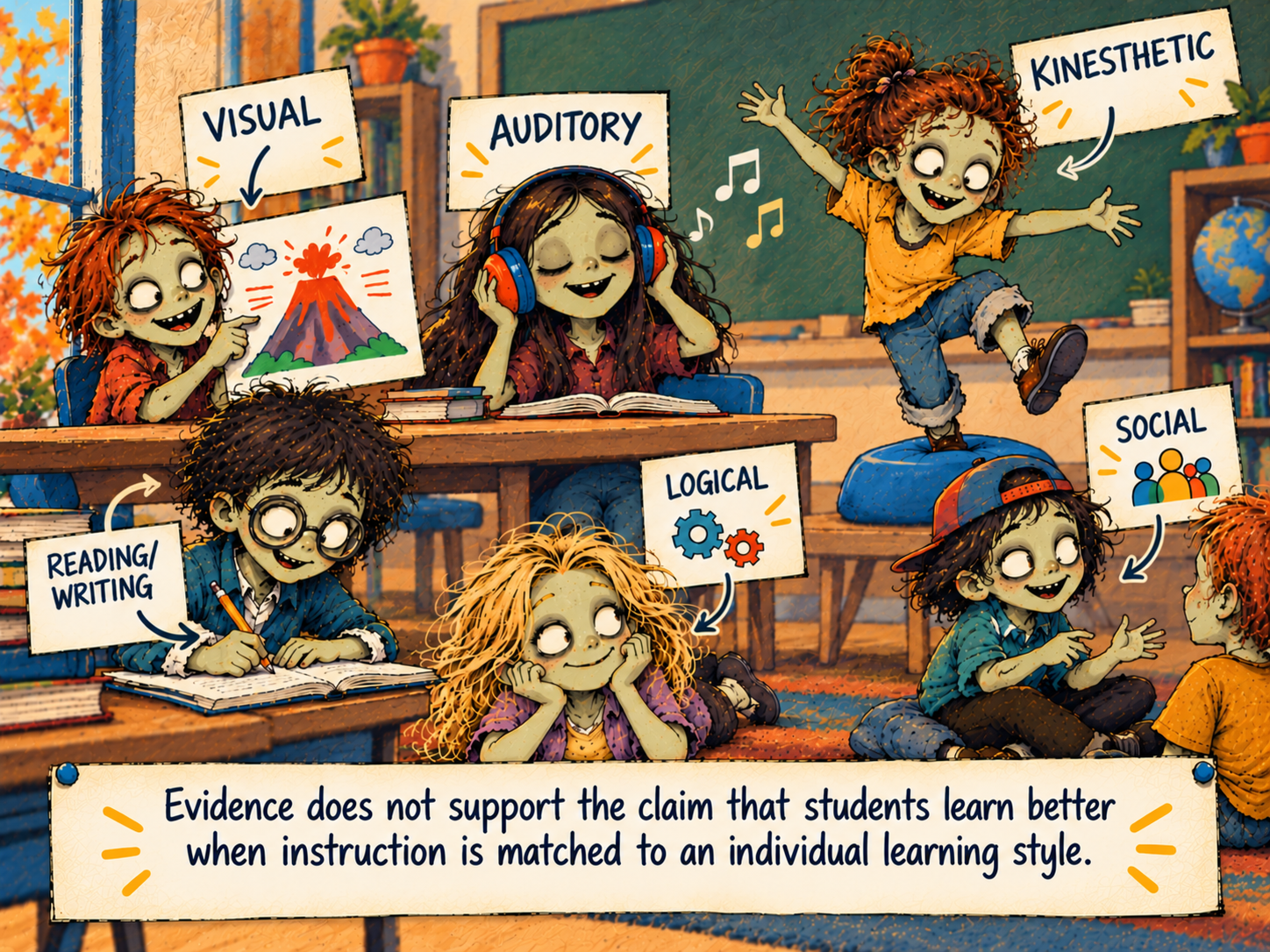
You’ve probably heard (or maybe even said yourself) some version of this before: “I’m a visual learner.” “He’s really kinesthetic.” “She learns better when she can hear it.”
For years, educators were taught that people could be categorized into learning styles and that instruction should be matched to those styles. Visual, auditory, and kinesthetic may be the three most familiar labels, but there are plenty of others floating around too. Reading/writing. Logical. Social. Solitary. There are still articles, quizzes, and resources telling teachers how to identify these supposed styles and adjust instruction accordingly.
This isn’t some relic buried in an old teacher-prep textbook. One article I found while working on this post was updated in August 2026 and lays out seven different learning styles, along with suggestions for how to teach to each one. It even recommends observing students carefully and customizing learning for them based on their identified style.
There are two problems with that.
|
|---|
A teacher with 20 students could potentially have students representing several different supposed styles in the same room. A secondary teacher might teach 150 or more students across the day. Are we really suggesting that effective instruction requires identifying each student’s style and then designing different versions of instruction to match each one?
One of the most interesting reactions I see when I share this research in trainings is relief.
Sometimes you can almost watch teachers’ shoulders drop. They have spent years believing they were supposed to somehow figure out every student’s learning style and then teach in a way that matched each one. That expectation was nearly impossible to meet.
Then they find out they don’t have to.
Matching instruction to individual learning styles is unrealistic in a real classroom, and the underlying premise itself isn’t supported by the evidence.
That realization can be freeing. Teachers can stop spending energy trying to diagnose and accommodate supposed learning styles and focus instead on choosing the representations, explanations, examples, and practice that best fit the content students are learning.
People absolutely have preferences. One person may prefer looking at a diagram. Another may prefer reading directions. Someone else may enjoy talking through an idea with another person.
Preference is different from a learning requirement.
The learning-styles theory makes a much bigger claim: that people learn better when instruction is delivered in the format that matches their individual style.
The evidence does not support that claim.
So, What Does the Evidence Actually Say? |
|---|
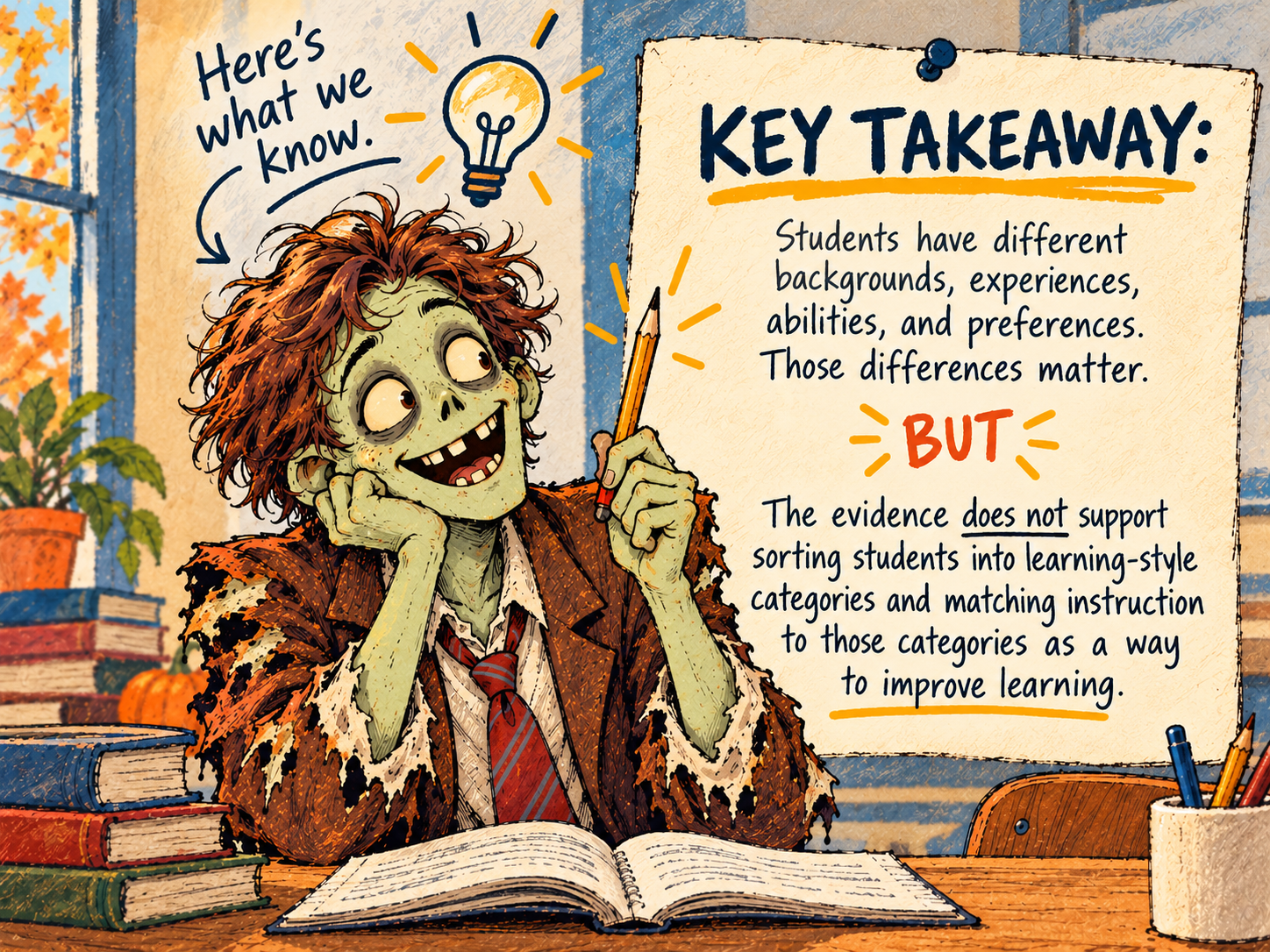
One of the most frequently cited reviews of learning styles comes from Harold Pashler, Mark McDaniel, Doug Rohrer, and Robert Bjork. They looked specifically at what would need to be true for the learning-styles claim to hold up. Remember, the claim isn’t simply that people have preferences. Researchers already have plenty of evidence that people prefer different ways of receiving information. The question is whether matching instruction to that preference improves learning. Researchers sometimes call this the meshing hypothesis. If it were true, we should see something pretty specific: students identified as visual learners should learn better from visual instruction, while students identified as auditory learners should learn better from auditory instruction. That pattern should actually show up in learning outcomes. Pashler and his colleagues reviewed the research and found virtually no evidence of it. Very few studies had even used a design capable of properly testing the claim, and several of the stronger studies produced results that contradicted it. Their conclusion was straightforward: there was no adequate evidence base for using learning-style assessments to guide instruction. Researchers have continued testing the idea since then. In a 2015 study, Beth Rogowsky, Barbara Calhoun, and Paula Tallal classified adults according to whether they preferred visual or auditory learning, then compared how well they learned through reading or listening. If the learning-styles claim were correct, the people identified as auditory learners should have done better when they listened, while visual learners should have done better when they read. They didn’t. Matching the mode of instruction to a person’s preferred learning style did not improve comprehension. Paul Kirschner has also written extensively about the persistence of this idea. In a 2017 article appropriately titled Stop Propagating the Learning Styles Myth, he distinguishes between having a preference for how information is presented and having a particular learning style that instruction needs to match. People certainly have preferences, but the evidence that those preferences represent distinct learning styles that instruction needs to match is remarkably weak. A few years earlier, Kirschner and Jeroen van Merriënboer included learning styles among what they called the “urban legends” of education. They examined the widespread belief that students learn better when instruction is individualized to match a preferred style and found that the research did not support it. None of this means learners are all the same. Students differ in background knowledge, abilities, interests, experiences, strengths, and preferences. Those differences absolutely influence learning. What the evidence has not shown is that sorting students into learning-style categories and matching instruction to those categories improves their learning. |
Why Is This Still So Believable?
Part of the reason learning styles have been so hard to shake is that the idea feels intuitively right. People clearly have preferences, so it’s easy to make one extra leap and assume those preferences tell us something about how they learn best.
Learning styles have also been reinforced for years through teacher preparation, professional development, online quizzes, classroom resources, and, as we’ve already seen, articles that continue to present them as settled fact. Many educators were never given a reason to question the idea in the first place.
So when I tell a room full of educators that learning styles aren’t supported by the evidence, the surprise makes sense. I believed in them once too.
“But I really am a visual learner.”
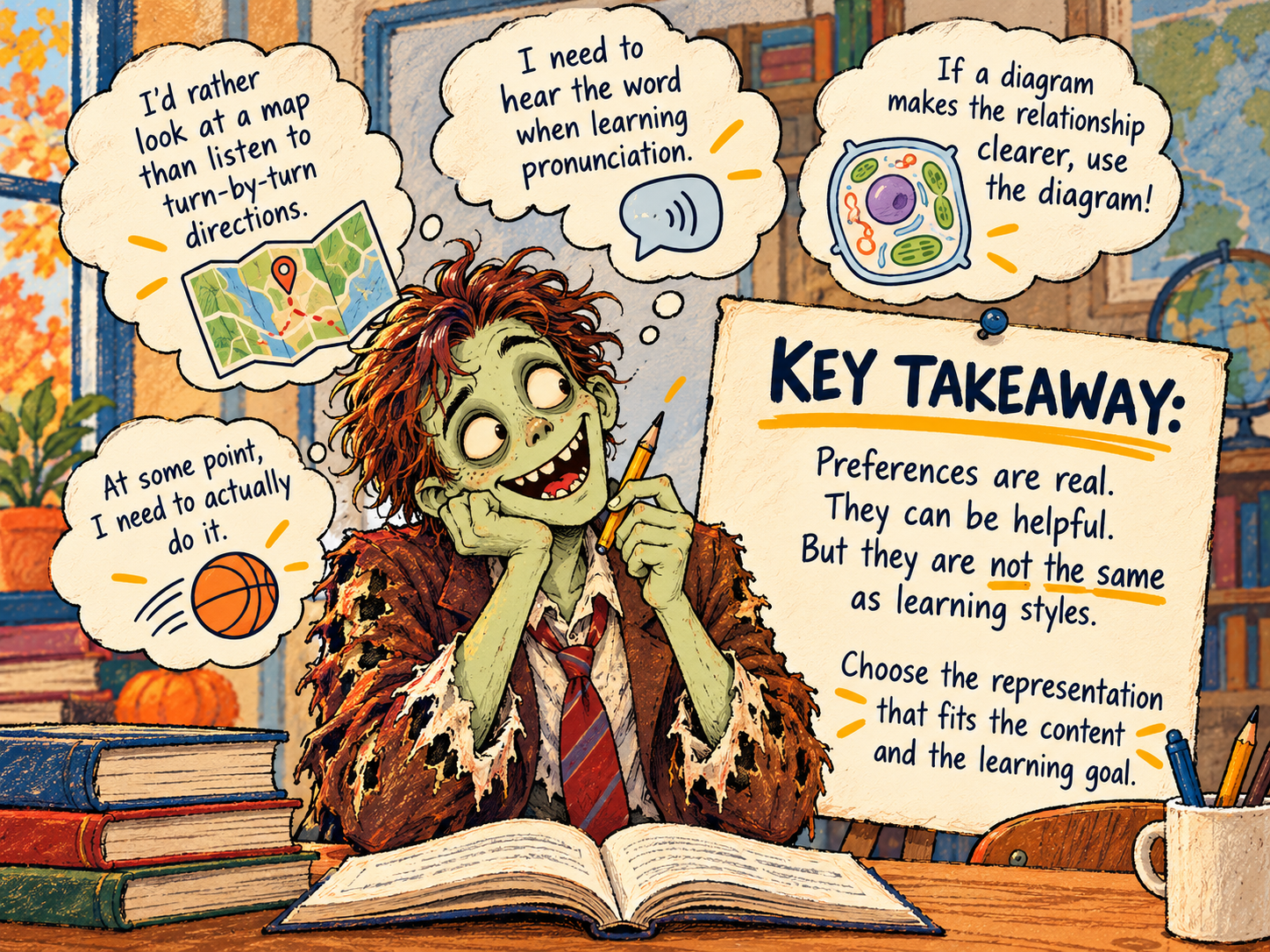
Maybe you really do prefer visual information. I probably do too in some situations. If someone is explaining how to get somewhere, I would much rather look at a map than listen to seven minutes of “turn left after the Walgreens, but not the first Walgreens.”
That preference doesn’t mean my brain has a visual learning style.
Tom Sherrington made this point beautifully during his opening keynote at researchED St. Louis. If we want students to learn where a country is located, we show them a map. We don’t show the map only to the students we’ve labeled “visual learners” while describing the location orally to the “auditory learners.” The visual representation makes sense because of what we are trying to teach.
The same principle applies elsewhere. If students are learning pronunciation in another language, they need to hear the word. If they are learning to shoot a basketball, at some point they need to physically shoot a basketball. If a diagram makes the relationship between parts of a cell clearer, use the diagram.
The representation should fit the content and the learning goal. We don’t need to sort students into categories first.
Where the Labels Can Get Us Into Trouble
The bigger concern is what happens when a preference turns into a label.
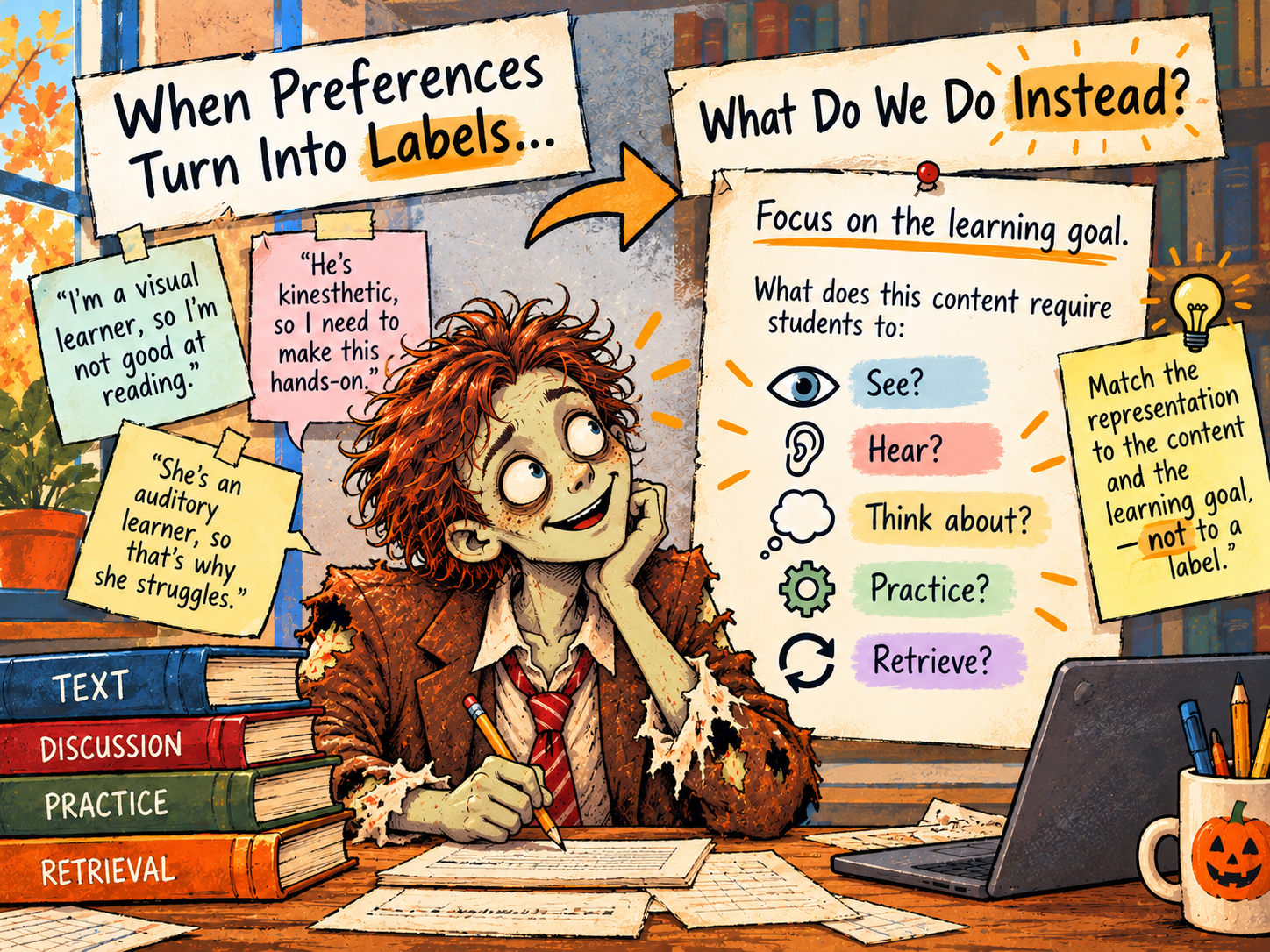
A student starts to believe, “I’m a visual learner, so I’m not good at learning from reading.”
A teacher assumes, “He’s kinesthetic, so I need to make this hands-on.”
A parent explains a struggle by saying, “She doesn’t learn well that way because she’s an auditory learner.”
Once the label becomes part of how we explain learning, it can quietly narrow what we expect students to be able to do.
Students need to learn from text sometimes. They need to listen carefully sometimes. They need to interpret visuals, discuss ideas, practice procedures, and work through tasks that may not match their preferred way of receiving information.
Preferences can influence what someone enjoys or finds comfortable. They don’t define what that person is capable of learning.
That’s why I’d rather spend our energy thinking about the demands of the content and the support students need to learn it well than trying to assign them to a learning-style category.
So What Do We Do Instead?
Instead of asking, “How do I teach this for my visual, auditory, and kinesthetic learners?” ask:
What does this content require students to see, hear, think about, practice, and retrieve?
That question keeps the focus where it belongs: on the learning goal.
Use a diagram when a diagram makes the idea clearer. Model something when students need to see the process. Let students discuss when talking through the thinking will help. Use manipulatives when they support understanding. Give students opportunities to retrieve and apply what they have learned.
We can still vary instruction. We can still use multiple representations. We can still pay attention to students’ needs.
We just don’t need to sort them into learning-style categories first.
And maybe that is one reason I love this particular zombie so much. Letting go of it doesn’t add another expectation for teachers.
It removes one.
Zombie #1, down.
You Don't Need to Plan for Seven Learning Styles. You Need to Plan for Learning.
Letting go of learning-style labels doesn't mean ignoring student differences. It means focusing your time and energy on the instructional decisions that actually support learning.
We've created a free Beyond Learning Styles: An Evidence-Informed Lesson Planning Guide to help you do just that.
Use it to identify what your students need to know, select representations that make the content clearer, plan purposeful practice, and build opportunities for students to retrieve and apply what they've learned.
Download your free guide and start planning for learning, not labels.
References & Further Reading
Culatta, R. (2024). Attack of the Zombie Learning Theories! ISTE+ASCD.
https://www.ascd.org/blogs/attack-of-the-zombie-learning-theoriesKirschner, P. A. (2017). Stop propagating the learning styles myth. Computers & Education, 106, 166–171.
https://doi.org/10.1016/j.compedu.2016.12.006 Stop propagating the learning styles myth - ScienceDirectKirschner, P. A., & van Merriënboer, J. J. G. (2013). Do learners really know best? Urban legends in education.Educational Psychologist, 48(3), 169–183.
https://doi.org/10.1080/00461520.2013.804395 Do Learners Really Know Best? Urban Legends in Education: Educational Psychologist: Vol 48, No 3Pashler, H., McDaniel, M., Rohrer, D., & Bjork, R. (2008). Learning styles: Concepts and evidence.Psychological Science in the Public Interest, 9(3), 105–119.
https://doi.org/10.1111/j.1539-6053.2009.01038 Learning Styles - Harold Pashler, Mark McDaniel, Doug Rohrer, Robert Bjork, 2008Rogowsky, B. A., Calhoun, B. M., & Tallal, P. (2015). Matching learning style to instructional method: Effects on comprehension.Journal of Educational Psychology, 107(1), 64–78.
https://doi.org/10.1037/a0037478 Matching Learning Style to Instructional Method: Effects on Comprehension | Request PDF


