
The Multitasking Myth Just Won’t Die | Uncomplicate Ed
TL;DR: The Multitasking Myth Just Won't Die
Think you're good at multitasking? Most of us do. We answer emails during meetings, check our phones while watching TV, and convince ourselves we're keeping up with everything. When two tasks demand our attention, though, our brains have to make choices. That changes how I think about what we ask students to do in classrooms. |
Multitasking is a myth.
Well, at least the kind most of us think we're good at.
I know. That can be a little hard to hear, especially if your immediate reaction is, But I’m really good at multitasking.
We do several things at once all day long, and our attention can move so quickly between tasks that the switching is almost invisible. It certainly feels like multitasking.
When two tasks both require real attention, though, our brains aren't processing them equally well at the same time. We're switching.
That distinction has become really obvious to me when I lead professional learning.
If I put something on a slide that I want participants to read, I have to stop myself from talking long enough for them to actually read it. If I want them to take notes, I need to give them a moment to write instead of continuing to explain the next idea. Sometimes I'll even black out the screen once we're ready to move into discussion.
As a presenter, the silence can feel strange. There is always a temptation to fill it. Giving people that space, though, gives them a chance to focus on the thing I want them thinking about.
Richard Culatta includes multitasking as one of the zombies in his ASCD article, Attack of the Zombie Learning Theories!. This may be one of the easiest zombie myths to keep believing because modern life gives us so much practice feeling like we’re doing several things at once.
The Zombie
What we usually call multitasking is much closer to task switching.
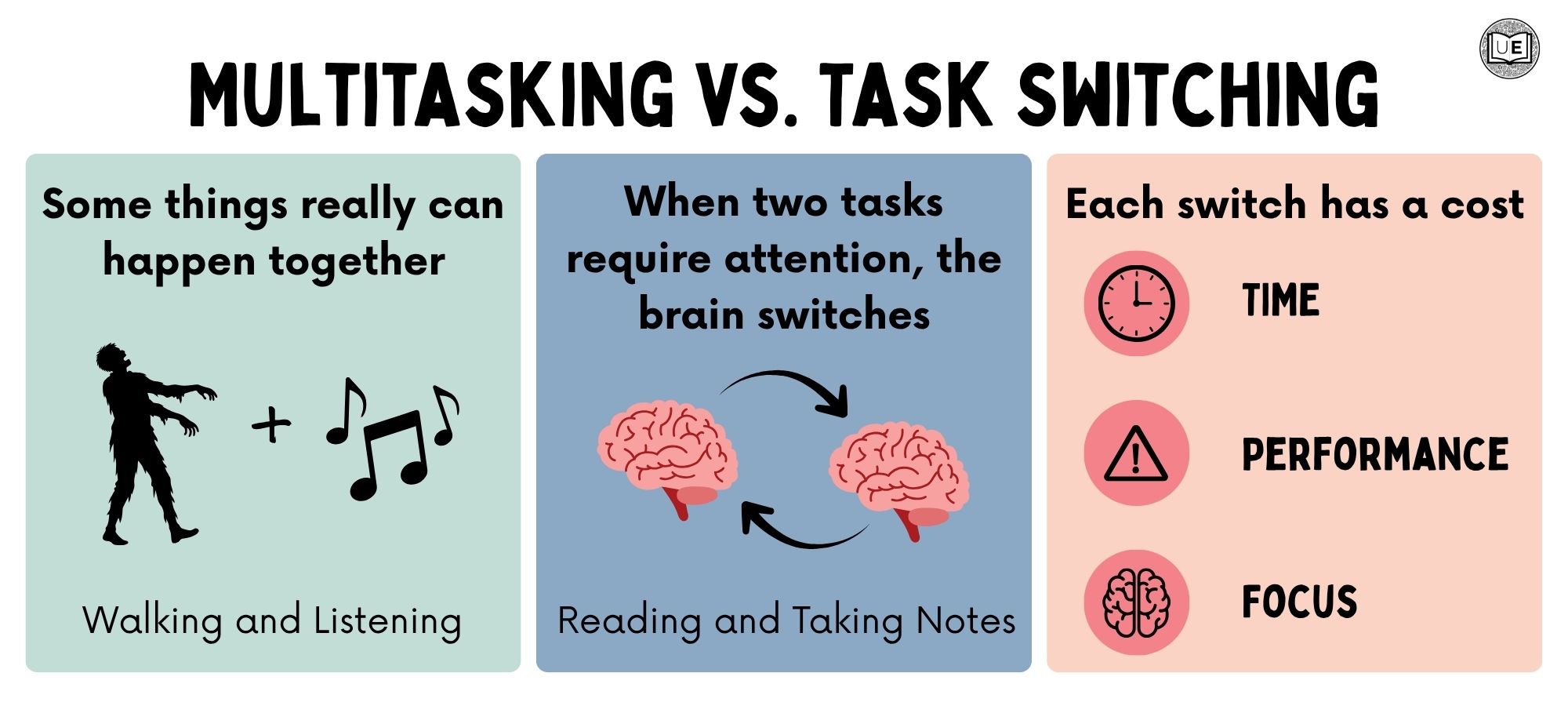
When two tasks both require attention, the brain shifts between them. Research on dual-task performance and task switching has documented the limits we run into when trying to coordinate multiple attention-demanding tasks. Iring Koch and colleagues, for example, reviewed decades of research on human multitasking and the cognitive processes involved in switching and coordinating tasks.
Each shift requires us to reorient to what we’re doing. That can slow performance, increase errors, and interfere with our ability to maintain focus on one task.
Of course, humans can physically do more than one thing at a time. I can walk and talk. I can fold laundry while listening to a podcast. I can drive a familiar route while music plays. Many of those behaviors have become automatic enough that they require relatively little conscious attention.
Learning something new is different.
When students are trying to make sense of unfamiliar content, hold information in working memory, connect ideas, follow directions, or solve a problem, their cognitive resources are already being used. Adding another attention-demanding task creates competition for those resources.
Sometimes We Create the Competition Ourselves
Phones and notifications are easy examples when we talk about distraction. I think educators also need to look at the competition for attention we sometimes build directly into instruction.
Go back to the training example.
If I put a paragraph on a slide and immediately start talking, participants now have to decide where their attention goes. They can read what I wrote. They can listen to me. They can bounce between the two. If they are also trying to take notes, I have added another demand.
From the front of the room, everyone may look wonderfully "engaged." After all, they're all doing something. Heads are down. Pens are moving. People are looking back and forth between me and the screen.
That tells me very little about how much of what I’m saying they are actually processing.
The same thing happens in classrooms. A teacher explains an idea while students copy notes from the board. A video continues playing while students answer questions about new information. Students are asked to read something on the screen while the teacher simultaneously explains what they should notice.
This is where one of my favorite planning questions becomes useful:
What do I want students thinking about right now?
Once we can answer that, we can look at the other things we are asking students to do and decide whether those demands support the thinking or compete with it.
When Instruction Competes for Attention
Cognitive Load Theory gives us another useful lens for thinking about instructional design.
Working memory has a limited capacity, particularly when we're dealing with new information. Instruction can make learning more difficult when students have to use some of that limited capacity managing unnecessary demands created by the way information is presented.
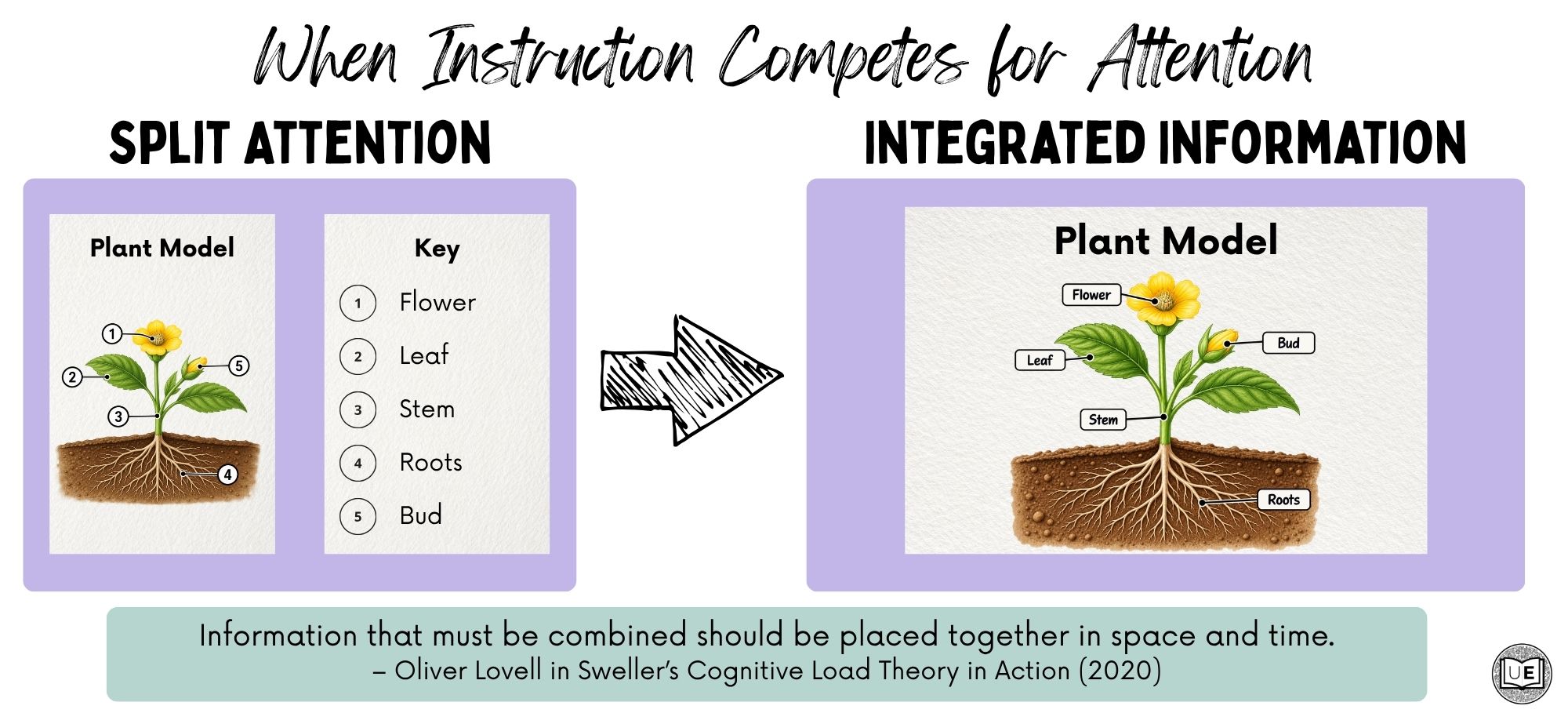
One example is the split-attention effect.
Chandler and Sweller (1992) originally used the term to describe situations in which learners must divide their attention between separate sources of information and mentally integrate them in order to understand the content. Imagine a diagram in one place and the explanation needed to understand it somewhere else. The learner has to repeatedly move between the two and mentally put the pieces together.
There's also the redundancy effect, which can occur when learners are given unnecessary duplicate information. For example, displaying a paragraph of text while reading it aloud word for word can create additional cognitive demands, particularly when learners could understand the information from one source alone (Kalyuga et al., 1999).
Task switching, split attention, and redundancy describe different cognitive challenges. Each gives us a reason to examine the demands we're placing on learners and whether those demands support or interfere with learning.
The key is being intentional about what information students need in front of them and when.
Text that requires careful reading may need a little quiet time before discussion begins. Diagrams and their explanations can be placed together so students aren't constantly searching between them. A visual that supports an explanation can remain visible while the teacher talks.
We want students to use their limited working memory to understand what they're learning, rather than spending unnecessary effort figuring out where to direct their attention.
You Can’t Really Listen to Two Conversations Either
There’s a classroom-management connection here that I think gets overlooked.
Students cannot fully attend to the teacher while carrying on a separate conversation with someone beside them. They also can’t give full attention to one student sharing an idea while they are talking to someone else.
Two streams of language are competing for attention.
That’s one reason I see classroom management and engagement as so closely connected. Clear routines around when students are listening, when they are talking, and when they are working independently help create conditions where students can engage in the thinking we are asking them to do.
A quiet room is certainly no guarantee of engagement. Students can sit silently and think about absolutely nothing we intended. Still, when listening is necessary for the learning, the classroom conditions have to make listening possible.
This Fits Right Into How We Think About Learning at Uncomplicate Ed
In our Uncomplicate Ed model of learning, engagement is one of the three pieces that come together to support students learning at high levels, alongside rigor and motivation. Those three sit inside the larger classroom conditions created through classroom management, teacher leadership, and physical and emotional safety.
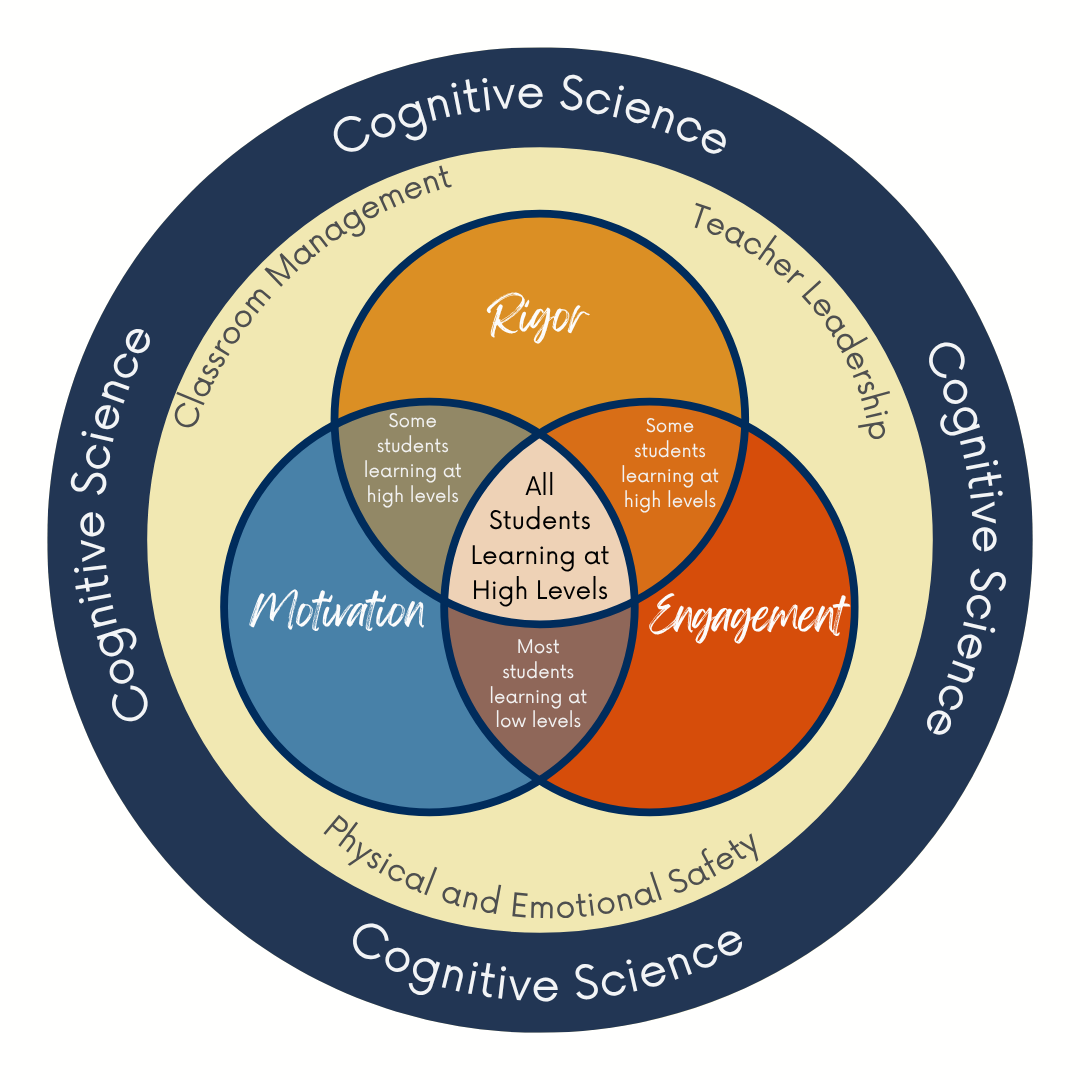
Cognitive science surrounds the entire model, informing how we approach rigor, motivation, engagement, and the classroom conditions that support learning.
The multitasking myth helps illustrate how these pieces connect. When students are asked to divide their attention across competing demands, their engagement in the intended learning can suffer. Classroom management helps protect attention through clear expectations for when students are listening, talking, reading, or working independently. Instructional design can reduce unnecessary competition for that attention in the first place.
This is also why one of my favorite questions about engagement is:
What evidence do we have that students are thinking?
A student doing several things at once can look very busy. That activity doesn’t necessarily tell us what the student is thinking about.
Sometimes engagement looks like discussion, movement, writing, or collaboration. Sometimes it looks like thirty seconds of quiet reading while the teacher says absolutely nothing.
The thinking is what we’re after.
So What Do We Do With This?
Two questions can help us think more intentionally about attention and engagement:
What do I want students thinking about right now?
What evidence do I have that they're doing that thinking?
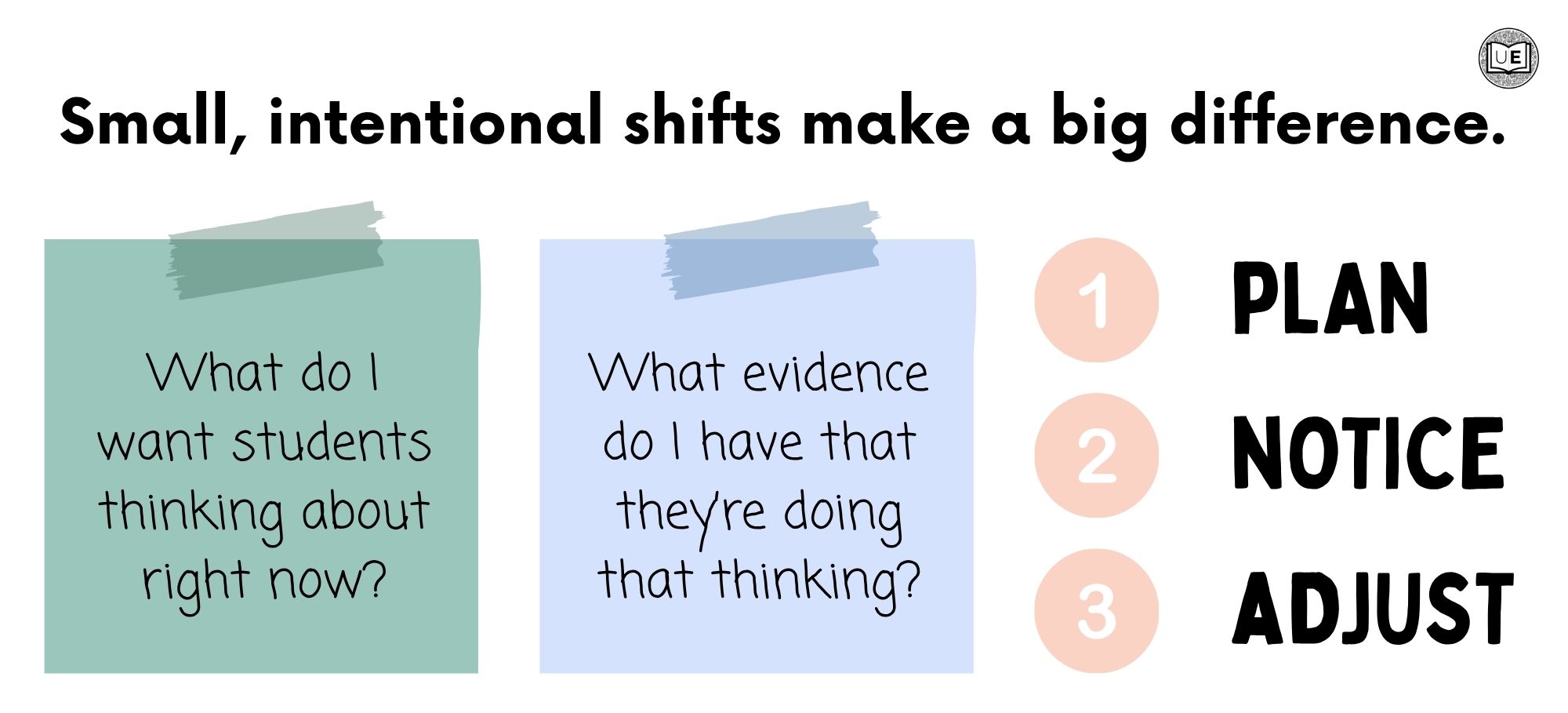
The first helps us plan. The second helps us look beyond whether students appear busy or engaged.
If the teacher explanation is the most important thing at that moment, students may need to listen before they write. If students need to read something new, give them enough time to read it before the discussion begins. If a visual helps students understand the concept, use it alongside the explanation. If students are talking while someone else is speaking, reset the expectation before adding more information.
Then pay attention to what students are doing with the information. Are their responses, questions, or work giving us evidence of the thinking we intended?
None of this requires perfectly controlled attention every second of the day. Human attention wanders. Students are human. Teachers are too.
We can, however, design classrooms and instruction with the limits of attention in mind.
Technology has changed dramatically. The basic architecture of human cognition hasn't changed at nearly the same pace.
Maybe that’s why this particular zombie keeps coming back. With all the technology and constant demands on our attention, you'd think we'd be getting better at multitasking.
Our brains have other plans.
Zombie #2, down.
Happy Halloween.
References & Further Reading
Chandler, P., & Sweller, J. (1992). The split-attention effect as a factor in the design of instruction.British Journal of Educational Psychology, 62(2), 233–246.
Culatta, R. (2024). Attack of the Zombie Learning Theories! ISTE+ASCD.
Kalyuga, S., Chandler, P., & Sweller, J. (1999). Managing split-attention and redundancy in multimedia instruction. Applied Cognitive Psychology, 13(4), 351–371.
Koch, I., Poljac, E., Müller, H., & Kiesel, A. (2018). Cognitive structure, flexibility, and plasticity in human multitasking: An integrative review of dual-task and task-switching research.Psychological Bulletin, 144(6), 557–583.
Sweller, J., van Merriënboer, J. J. G., & Paas, F. (2019). Cognitive architecture and instructional design: 20 years later.Educational Psychology Review, 31, 261–292.


