
You Can't Activate What Isn't There: A Veterans Day lesson in building the background knowledge students need to understand history.
You Can't Activate What Isn't There
Using Veterans Day to explore how background knowledge supports comprehension and historical thinking.
A student might be able to tell you that Veterans Day is November 11 and that it's a day to honor people who have served in the military...
Could that same student explain why November 11 was chosen? What World War I has to do with the holiday? Or why Veterans Day and Memorial Day recognize different things?
Those are pieces of historical knowledge that help students understand the holiday beyond its date and purpose. They're also the kinds of connections students need when reading historical texts, examining primary sources, or explaining the significance of an event.
We talk a lot in education about activating prior knowledge. I'm all for it, when students have relevant knowledge to activate.
We can't activate knowledge students don't have yet. Sometimes we have to build it first.
With Veterans Day approaching, I thought this would be a useful opportunity to look at what that can mean for classroom instruction.
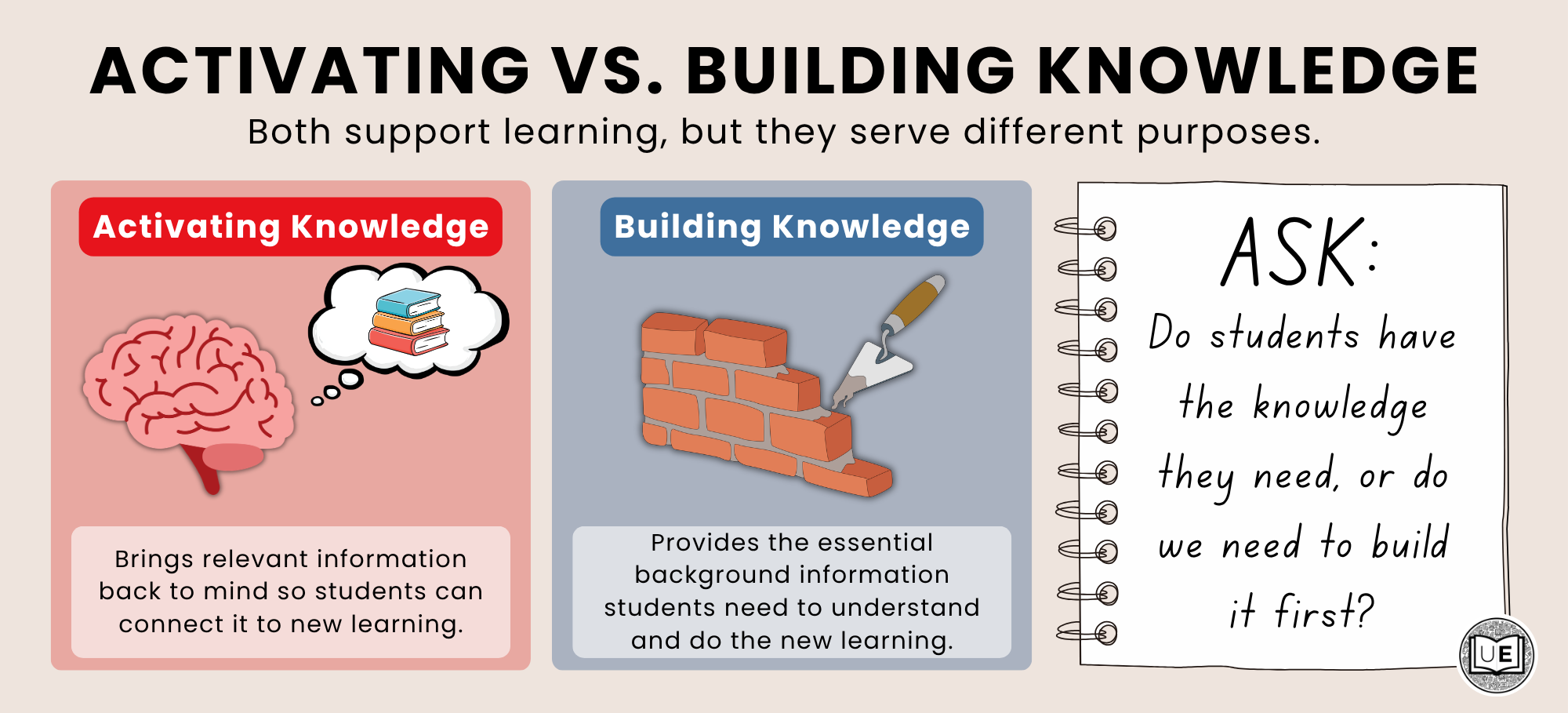
Activating Knowledge and Building Knowledge Are Different
Teachers are often encouraged to "activate prior knowledge" at the beginning of a lesson.
That can be useful. Bringing relevant information back to mind can help students connect new learning to something familiar. It can also give teachers an opportunity to identify misconceptions or gaps in understanding.
If students have never learned about World War I, though, asking what they know about Veterans Day won't suddenly give them the historical context they need.
Before asking students to analyze a text or primary source about Veterans Day, we may need to provide some of that context. A short explanation of World War I, the armistice of November 11, 1918, and how Armistice Day later became Veterans Day can help students understand why the holiday exists. Students may also need to learn how Veterans Day differs from Memorial Day.
This doesn't require an hour-long lecture before students can do anything meaningful.
A short informational text, a simple timeline, a few carefully chosen images, and explicit instruction around unfamiliar vocabulary may be enough to give students a foundation for what comes next.
Students won't all arrive with the same knowledge, of course. Some may already understand the historical context, while others are encountering these ideas for the first time. We can use what we learn about students' existing knowledge to decide what needs to be reviewed, clarified, or explicitly taught.
The planning question becomes:
What do students need to know to make sense of what I'm asking them to learn or do?
Then Give Students Something to Do With That Knowledge
Once students have some historical context, they can begin using it to make sense of primary and secondary sources.
A 1919 photograph from the Library of Congress gives us a way to put that knowledge to work. It shows enormous crowds gathered in Buffalo, New York, to welcome home soldiers returning from World War I.
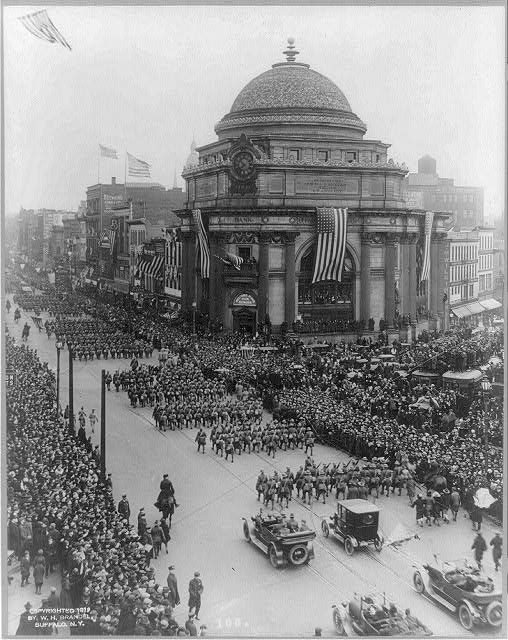
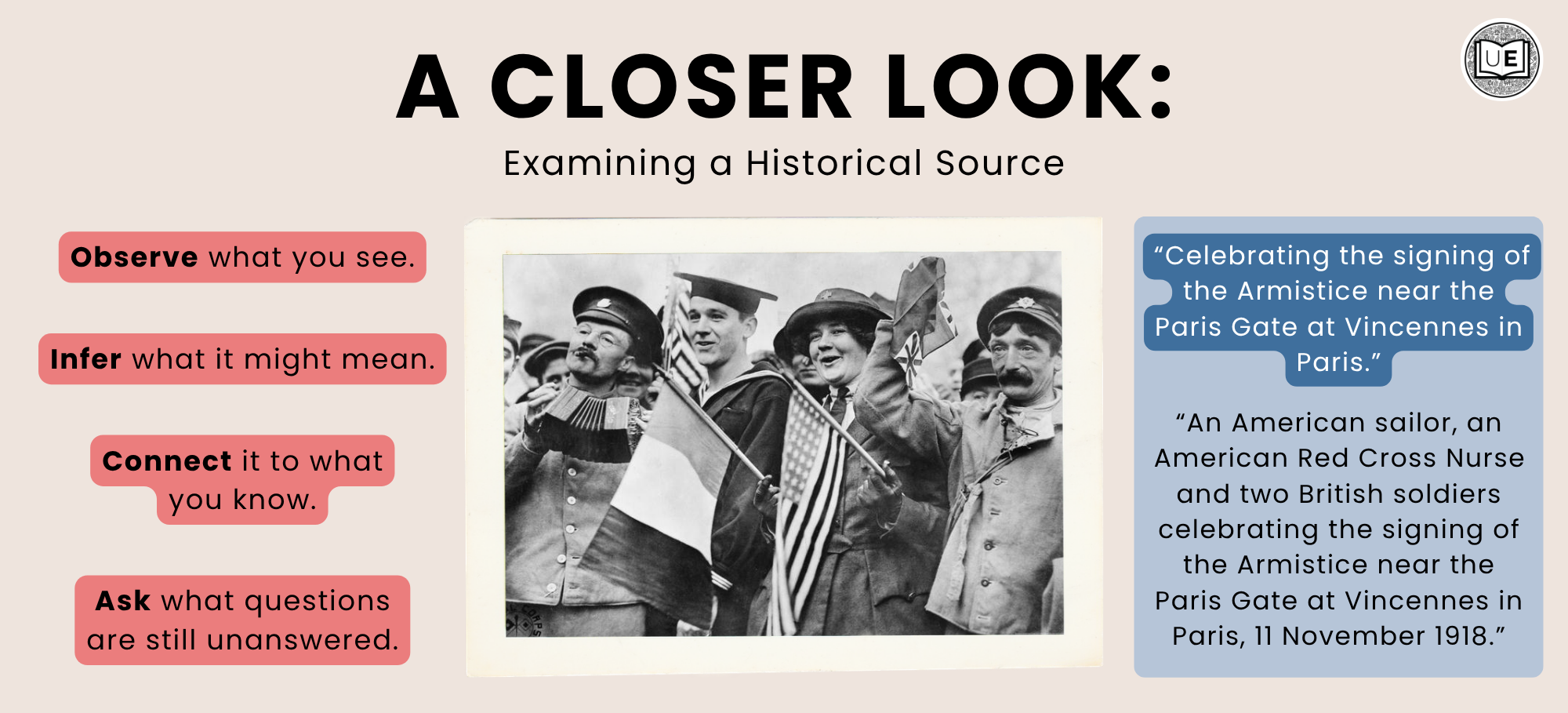
Students can begin by describing what they notice: American flags, crowded streets, people watching from rooftops and automobiles, and a message welcoming home the soldiers.
With some historical context, students can begin asking more meaningful questions. Why were so many people gathered? What had happened in the war? What might this celebration tell us about how returning soldiers were publicly received?
They can also consider what the photograph doesn't tell us. Does a large public celebration mean that every returning soldier had the same experience? What additional sources might help us understand those experiences?
As students examine the photograph, we can model how to connect observations to historical knowledge, distinguish evidence from inference, and recognize the limitations of a source. Students can learn to use what they know without making claims that go beyond the evidence.
We're building historical knowledge while also teaching students how historians use evidence to develop and support interpretations.
A Simple Veterans Day Lesson Sequence
Here's one way to put these ideas into practice, drawing on several of Rosenshine's Principles of Instruction (2012), including presenting information in manageable steps, modeling new thinking, guiding practice, and checking for understanding.
The sequence can be adjusted based on students' ages, what they already know, and the historical sources you choose.
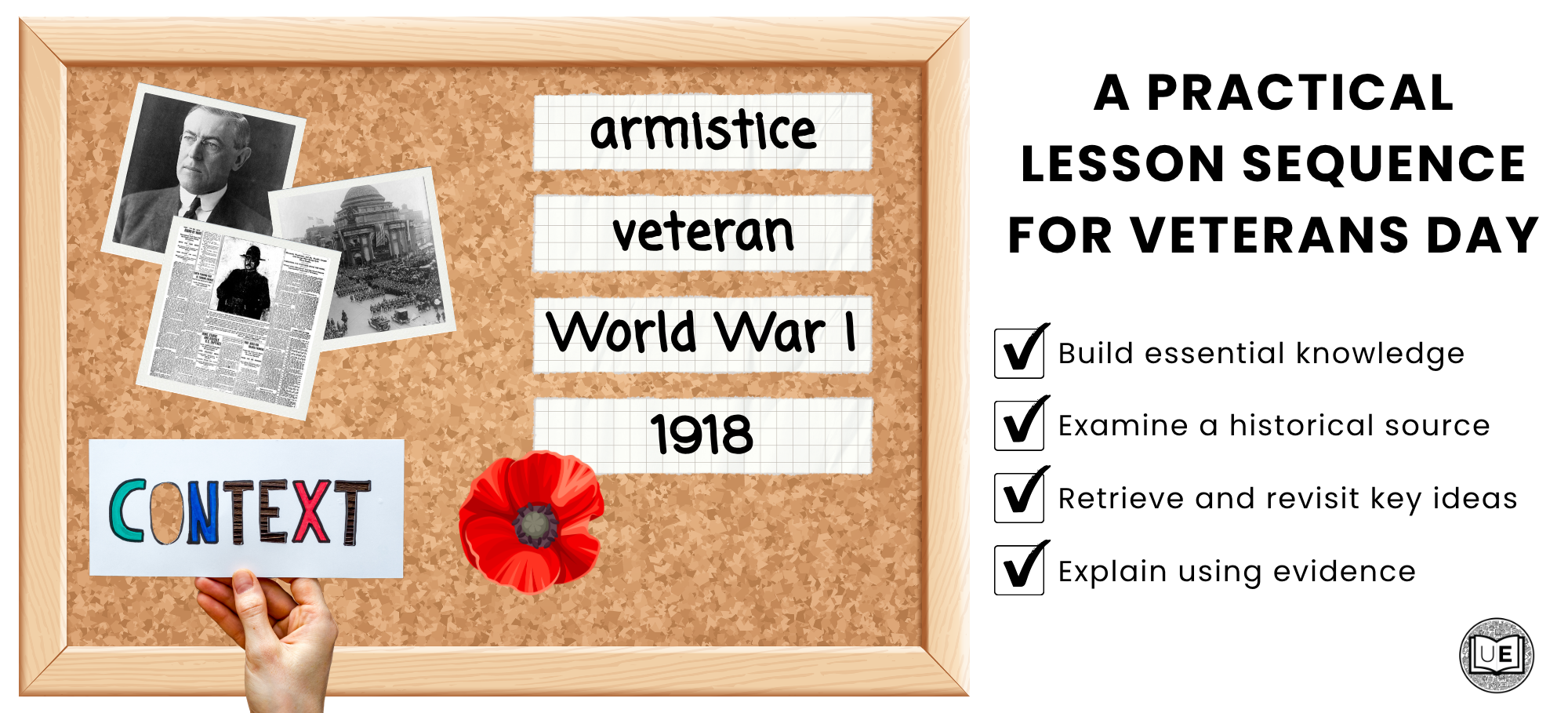
1. Build the Essential Knowledge
Begin with a short historical overview that helps students understand the origins of Veterans Day.
Introduce the relationship between World War I, the armistice that took effect on November 11, 1918, and the original observance of Armistice Day. Explain how the United States later expanded the holiday to honor American veterans of all wars.
A simple timeline can help students organize these events:
1918: An armistice takes effect on November 11, ending major fighting on the Western Front during World War I.
1919: President Woodrow Wilson proclaims the first Armistice Day observance.
1938: November 11 becomes a federal legal holiday known as Armistice Day.
1954: The holiday is renamed Veterans Day to honor American veterans of all wars.
You can find additional historical information through the U.S. Department of Veterans Affairs.
Explicitly teach vocabulary students will need, such as armistice and veteran. Clarify that Veterans Day honors those who have served in the U.S. Armed Forces, while Memorial Day specifically honors military personnel who died while serving in the military.
Keep the initial explanation focused on what students will need for the source analysis that follows.
2. Examine a Historical Source
Use the Buffalo photograph above or choose another age-appropriate primary source that connects to the historical knowledge students have just learned.
Model how to examine the source, drawing attention to what students can observe, what they can reasonably infer using their historical knowledge, and what questions remain unanswered.
Then give students an opportunity to practice that thinking themselves, with support as needed.
The Library of Congress Veterans History Project is another resource for finding firsthand accounts and materials from American veterans.
3. Retrieve and Revisit
Throughout the lesson, give students opportunities to recall important ideas without immediately looking back at their notes.
For example:
Why is Veterans Day observed on November 11?
How did Armistice Day become Veterans Day?
How is Veterans Day different from Memorial Day?
What historical information helped you better understand the source we examined?
Retrieval practice gives students opportunities to strengthen their ability to bring learned information back to mind.
Dunlosky and colleagues (2013) identified practice testing and distributed practice as especially useful learning techniques.
We can apply those findings by revisiting important information after some time has passed, rather than treating the lesson as a one-day activity. A few retrieval questions later in the week or during a future history lesson can help students continue strengthening that knowledge.
4. Explain Using Evidence
Now give students an opportunity to use their historical knowledge and evidence from the source to construct an explanation.
For example:
What does this historical source help us understand about the experiences of veterans? Use evidence from the source and what you've learned about Veterans Day to support your explanation.
Depending on the source and grade level, students might respond through discussion, a short written explanation, or a more developed historical analysis.
Their responses give us information about what they've understood, what connections they're making, and what may need additional instruction.
The Bigger Idea
The same principle applies well beyond Veterans Day. Whether students are studying the American Revolution, the Civil Rights Movement, a scientific discovery, or a complex piece of literature, what they already know influences what they can understand.
As we plan, it's worth asking whether students have the knowledge they'll need for the thinking we're asking them to do. If they don't, we have an opportunity to build it.
With Veterans Day approaching, a little intentional knowledge building can help students move beyond knowing that we observe November 11 and toward understanding why.
To the veterans in our schools and communities, including those who have continued their service in classrooms, thank you.

References & Further Reading
Dunlosky, J., Rawson, K. A., Marsh, E. J., Nathan, M. J., & Willingham, D. T. (2013). Improving students' learning with effective learning techniques: Promising directions from cognitive and educational psychology. Psychological Science in the Public Interest, 14(1), 4–58.
https://doi.org/10.1177/1529100612453266
Rosenshine, B. (2012). Principles of instruction: Research-based strategies that all teachers should know. American Educator, 36(1), 12–19, 39.
https://www.aft.org/ae/spring2012/rosenshine
Smith, R., Snow, P., Serry, T., & Hammond, L. (2021). The role of background knowledge in reading comprehension: A critical review. Reading Psychology, 42(3), 214–240.
https://doi.org/10.1080/02702711.2021.1888348
Sweller, J. (1988). Cognitive load during problem solving: Effects on learning. Cognitive Science, 12(2), 257–285.
https://doi.org/10.1016/0364-0213(88)90023-7
Historical Resources
Library of Congress. Large parade welcoming Armed Forces home, Buffalo, New York, 1919.
https://www.loc.gov/pictures/item/2013648114/
Library of Congress. Veterans History Project.
https://www.loc.gov/programs/veterans-history-project/about-this-program/
U.S. Department of Veterans Affairs. History of Veterans Day.
https://department.va.gov/veterans-day/history-of-veterans-day/


