Math Fact Fluency in Florida: What Should Be Mastered, and When?
Florida tells us what students should know. The Math Roadmaps clarify what to build, when to practice, and when recall is secure enough to support the next math.
Florida’s B.E.S.T. Standards are clear about several math fact recall expectations, including in grades 1, 2, and 4. The Uncomplicate Ed Math Roadmaps include those Florida expectations, but they also add two important layers.
First, the Roadmaps include small, intentional recall targets in Kindergarten and Grade 3.
Second, the Roadmaps identify when each recall target should be moving toward mastery during the school year.
Why? The Roadmaps are designed to help teachers answer two practical questions:
What facts matter?
And when should students be able to retrieve them with reasonable ease?
Why Recall of Facts Matters
Working memory is limited. When students are learning something new, they can only hold and manipulate so much information at once.
Cognitive Load Theory helps explain why this matters. New information places demands on working memory. Knowledge stored in long-term memory can often be accessed with far less effort, which leaves more mental space for new learning (Sweller, van Merriënboer, & Paas, 2019).
Imagine a student solving a fraction problem.
The student may need to determine what the problem is asking, find a common denominator, keep track of several steps, calculate accurately, and decide whether the answer makes sense.
Now imagine that same student also has to stop and figure out 6 × 8 by skip counting.
Part of that limited working-memory capacity is now being spent on a basic calculation instead of the fraction work.
This is why fact knowledge matters. Math facts are not more important than reasoning. Strong fact knowledge supports reasoning.
When 6 × 8 is readily available as 48, students have more attention available for the mathematics they are actually trying to learn.
The Roadmaps Recall Progression
The progression often includes counting, modeling, reasoning, using strategies, purposeful practice, and repeated retrieval. It is not always a perfectly neat sequence. Sometimes students understand a concept first and then build recall. Sometimes repeated practice with a fact or procedure helps students notice patterns and deepen understanding later.
In real classrooms, understanding, practice, procedures, and memory often develop together.
Here is how the Uncomplicate Ed Math Roadmaps organize math fact recall across the elementary grades.
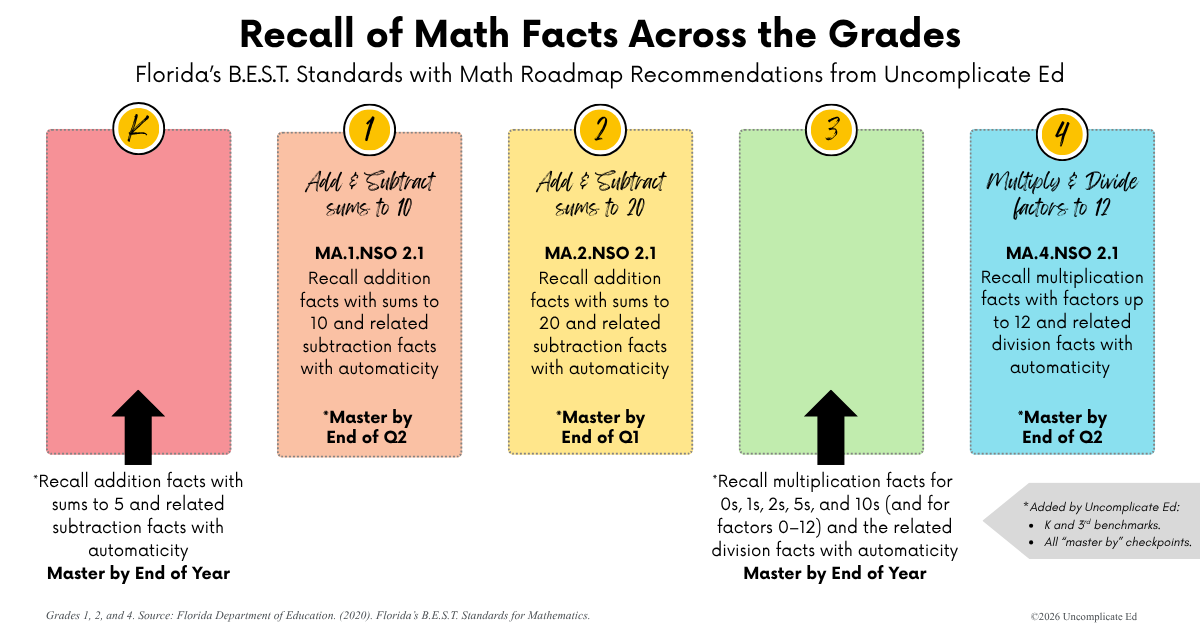
Click HERE to download the graphic.
There are two important things to notice:
The Kindergarten and Grade 3 recall targets are Roadmap recommendations, not additional Florida benchmarks. We added them as smaller bridge points toward the automaticity Florida expects later.
The suggested mastery points matter, too. Students do not stop practicing after those points, but the facts need to become reliable early enough to support the rest of the year’s mathematics.
Why We Added Kindergarten
In Kindergarten, students are learning number sequences and building the meaning of addition and subtraction.
Florida expects students to count by ones and tens to 100. Students also explore addition and related subtraction within 10 and work toward solving those operations reliably.
In the Math Roadmaps, we add one small recall target:
Recall addition facts with sums to 5 and related subtraction facts by the end of Kindergarten.
This is not the Grade 1 automaticity benchmark moved into Kindergarten.
It is a small, manageable foundation.
Facts like 2 + 3, 4 + 1, 5 - 2, and 5 - 4 can begin moving into memory while students continue developing understanding within 10.
Why? Grade 1 has its own automaticity expectation. Students are expected to recall addition facts with sums to 10 and related subtraction facts with automaticity. In the Roadmaps, we suggest that benchmark be mastered by the end of Quarter 2.
A student who enters Grade 1 already able to retrieve a small set of facts within 5 has a stronger starting point for that work.
Why We Added Grade 3
Grade 3 begins the multiplication and division version of the same progression.
Florida asks students to explore multiplication and related division facts through 12 and develop procedural reliability with those facts. Full automatic recall comes in Grade 4, when students are expected to recall multiplication facts with factors up to 12 and related division facts with automaticity.
In the Grade 3 Math Roadmaps, we add an intermediate recall target:
Recall the 0s, 1s, 2s, 5s, and 10s multiplication facts and related division facts by the end of Grade 3.
Again, this is a Math Roadmaps recommendation, not an additional Florida benchmark.
Why? We added it because it creates a bridge. The 0s, 1s, 2s, 5s, and 10s connect naturally to patterns, skip counting, repeated addition, equal groups, and place value. They also give students a useful bank of known facts before Grade 4 asks them to recall the full multiplication and division fact set (and before all the work in decimals and deep understanding of the base-ten system).
Those known facts can support unfamiliar ones.
If a student knows:
5 × 7 = 35
then:
6 × 7
can be reasoned as:
35 + 7 = 42
The known fact supports the strategy. With enough successful practice and retrieval, 6 × 7 can eventually become a known fact too.
What about 5th grade+?
By Grade 5 and beyond, the Roadmaps do not add new basic fact recall benchmarks. That does not mean fact fluency stops mattering. Address missing facts as repair work, not as new grade-level content.
A fifth, sixth, or seventh grader who still does not know key facts needs targeted support. They also need access to grade-level mathematics while that support happens.
We recommend doing both:
Keep grade-level instruction going while deliberately repairing the missing foundational knowledge.
During grade-level instruction, a student may still need a multiplication chart, calculator, or another support so the missing fact does not block access to the actual learning target.
Then, separately, keep working on the missing facts.
Support the student now while building toward less support later.
Free Download
To access a download of our recall graphic based on Florida's B.E.S.T. Standards and our Math Roadmaps, go HERE.
The Bottom Line
Math fact instruction is not a choice between understanding and memorization.
Students need understanding. They need strategies. They need practice. And some foundational knowledge eventually needs to become readily available from memory.
Need a resource for implementing fact practice in less than 10 minutes a day? Facts on Fire, by Brian Poncy, is completely free AND research-tested to have positive impacts.
Research and Resources
Florida Department of Education.Florida’s B.E.S.T. Standards for Mathematics and B.E.S.T. Instructional Guides for Mathematics.
Florida’s elementary standards establish the progression from early counting and operation meaning to procedural reliability and automatic recall.
National Mathematics Advisory Panel. (2008). Foundations for Success: The Final Report of the National Mathematics Advisory Panel. U.S. Department of Education.
The report describes conceptual understanding, computational fluency, and problem-solving as mutually reinforcing and emphasizes the importance of automatic recall of basic facts.
Poncy, B. C., Skinner, C. H., & Axtell, P. K. (2010). An investigation of Detect, Practice, and Repair to remedy math-fact deficits in a group of third-grade students. Psychology in the Schools, 47(4), 342–353.
This study examined targeted multiplication-fact intervention in which specific deficient facts were identified and addressed through focused practice, feedback, and brief fluency work.
Sweller, J., van Merriënboer, J. J. G., & Paas, F. (2019). Cognitive architecture and instructional design: 20 years later. Educational Psychology Review, 31, 261–292.
This review of Cognitive Load Theory explains the limits of working memory and the role of knowledge stored in long-term memory in supporting more complex learning.
Purchase Now
Purchase from our store now HERE.
Purchase with a tax-exempt for HERE.
Purchase the standalone anchor charts HERE.